

iStent in Annecy: A Revolution in the Combined Treatment of Glaucoma and Cataract
On Thursday, 12 June 2025, Dr Florian Baudin shared significant advances in the treatment of glaucoma, particularly the results of his experience in Annecy with the iStent® inject W implant. This cutting-edge technology, which is part of minimally invasive glaucoma surgeries (MIGS), transforms the care of patients suffering from both cataract and glaucoma. The results, based on a personal study conducted in 2023–2024 on 66 eyes, as well as on the latest scientific data, are extremely promising. They confirm excellent effectiveness in controlling intraocular pressure, remarkable safety, and, most importantly, a major benefit for patients' quality of life: the possibility of stopping glaucoma eye drops (drops).
Understanding Cataracts and Glaucoma: Two Enemies of Vision
For many patients, the diagnosis of cataracts is accompanied by a follow-up for glaucoma. These two diseases, although different, affect vision, and their coexistence requires a well-thought-out treatment strategy.
What is a cataract?
A cataract is the natural clouding of the lens, the transparent structure located inside the eye. Over time, this lens loses its transparency, leading to well-known symptoms:
- Blurred vision, as if looking through fog.
- Sensitivity to bright lights (car headlights, sunlight).
- Altered color perception, which appears duller.
The only treatment for cataracts is surgical, involving the replacement of the opaque lens with a perfectly transparent artificial implant.
What is glaucoma?
Glaucoma is a chronic and progressive disease of the optic nerve, the "cable" that transmits visual information from the eye to the brain. The main cause of optic nerve damage is excessive intraocular pressure (IOP). The fluid inside the eye (aqueous humor) has difficulty draining, increasing the pressure. Glaucoma is a silent and insidious disease, as it causes no pain and only affects vision in an advanced stage. The first-line treatment involves the daily instillation of eye drops (drops) to lower the pressure. However, this treatment is restrictive, often lifelong, and can cause irritation, redness, and dry eyes.
Link to the dedicated page on the website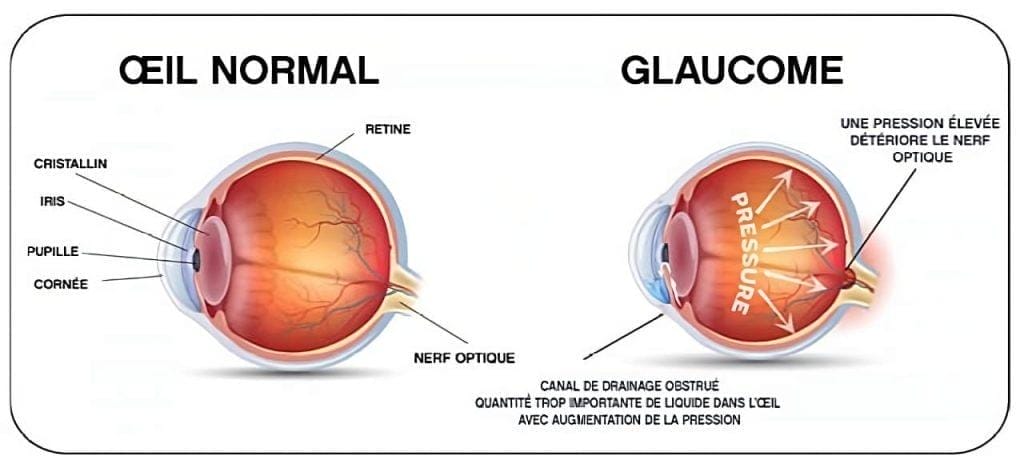
Combined Surgery with iStent® inject W: A Two-in-One Solution
The idea of combined surgery is simple and logical: to take advantage of the cataract surgery to also treat glaucoma at the same time. This is where iStent comes in.
What is iStent® inject W?
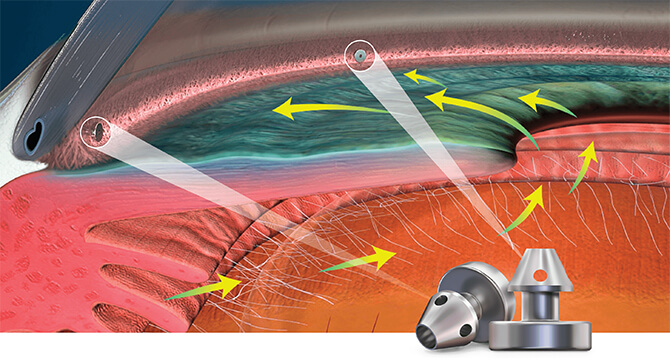
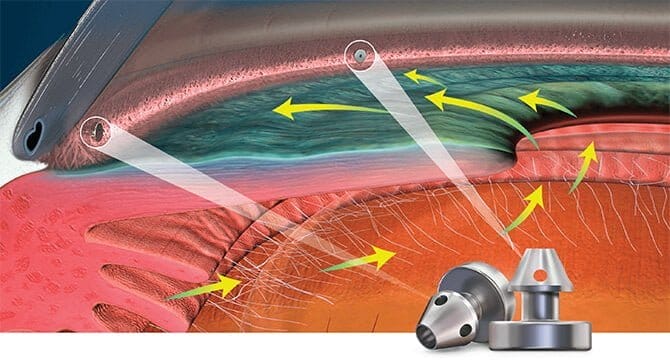
The iStent inject W is the smallest medical implant known in the world. This high-tech device, made from biocompatible titanium, measures just 360 microns (approximately one-third of a millimeter). It is a MIGS (Minimally Invasive Glaucoma Surgery) procedure. Its principle is to create a permanent micro-bypass within the eye. The implant is inserted through the natural filtration area of the eye, which has become less permeable over time (the trabecular meshwork), to restore direct access to the natural outflow pathway (the Schlemm's canal). By restoring this drainage, the intraocular pressure decreases mechanically. The "inject W" model uses two stents placed in separate locations to optimize drainage and provide more stable and significant results.
Surgical implantation video
Advantages of the Combined Approach
- One procedure: Less stress, one anesthesia (typically just eye drops) and one recovery period.
- Maximum safety: The procedure is minimally invasive. The surgeon uses the same incision as for cataract surgery, and adding the iStent takes only a few minutes, without increasing the risks of the operation.
- Comfort and quality of life: The ultimate aim is to control glaucoma while freeing the patient from the daily burden of eye drops.
What do the studies say? Results of recent iStent studies
The effectiveness and safety of the iStent inject W implant are not solely based on the experience of surgeons such as Dr Baudin, but are also firmly validated by numerous rigorous international scientific studies. Here is what the latest research tells us.
Lowered Pressure and Cessation of Long-Term Treatment
The studies consistently confirm that adding the iStent to cataract surgery is more effective than cataract surgery alone.
- À 2 ans : L'étude pivot de référence (Samuelson et al., Ophthalmology, 2019) a montré qu'à 24 mois, la baisse de pression était significativement plus importante avec l'iStent (-7.0 mmHg) et que 84% des patients n'avaient plus besoin de traitement.
- À 5 ans : Une étude récente (Guedes et al., Ophthalmology and Therapy, 2022) confirme que l'efficacité se maintient sur le long terme, avec deux tiers des patients toujours sans médicament à 5 ans.
- À 7 ans : Pour évaluer la durabilité, l'étude de Manchester (Ziaei H, et al., Eye, 2021) a suivi des patients implantés avec la première génération d'iStent pendant 7 ans. Elle a confirmé que la réduction de pression restait stable, prouvant la fiabilité du concept sur le très long terme.
An Exceptional Safety Profile, Confirmed Over Time
Safety is an essential criterion, particularly for a surgical procedure. On this point, the literature is unanimous.
- Sécurité Globale : La méta-analyse de la collaboration Cochrane (Bicket et al., JAMA Ophthalmology, 2021), qui est le plus haut niveau de preuve scientifique, a conclu que le profil de sécurité de la chirurgie combinée est superposable à celui de la chirurgie de la cataracte seule.
- Complications Tardives : Elles sont extrêmement rares. L'étude de Manchester (Ziaei H, et al., Eye, 2021) n'a rapporté aucune complication liée à l'implant (migration, blocage, inflammation chronique) après 7 ans de suivi.
An Additional Benefit: Improved Eye Surface
Chronic treatment with eye drops is known to cause dryness and irritation of the eyes. By allowing patients to discontinue these treatments, iStent directly improves the health of the ocular surface. Studies (Schweitzer et al., Ophthalmology and Therapy, 2020) have shown a significant improvement in symptoms of dryness and clinical signs after the procedure.
Results and Efficacy: The Experience of Dr Florian Baudin in Annecy
Dr Baudin's presentation highlighted the excellent results achieved with his own cohort of patients followed in Annecy.
- Cohort: 66 eyes operated on between 2023 and 2024.
- Average age: 74.9 years.
- Initial condition: Patients had an average intraocular pressure of 20.3 mmHg under a mean treatment regimen of 2.02 drops before surgery.
Significant and Durable Pressure Reduction
Within 3 months of the intervention, the average intraocular pressure had decreased by 24%. These results, maintained over the long term, are perfectly in line with major international studies.
The Major Benefit: Stopping Eye Drops for Most Patients
The most important result concerns the discontinuation of treatment. In Dr. Baudin's cohort:
- 80% of patients no longer required any glaucoma eye drops 3 months after the operation.
- At the last follow-up (an average of 10 months), 85.5% of patients had stopped or reduced their treatment.
- If we exclude patients with terminal glaucoma or a functional single-eye condition, which would necessitate continued treatment, then 90% had no treatment at the last follow-up.
This therapeutic withdrawal has a direct impact on quality of life: no more missed doses, side effects, and associated costs.
The iStent: A Versatile Solution, Including for Complex Cases
The presentation also highlighted the versatility and safety of the iStent, even in very complex surgical situations.
Case 1: Axenfeld-Rieger Syndrome in a Single Eye
Dr Baudin presented the case of a 69-year-old patient, whose condition had been discussed at a conference at the University Hospitals of Geneva (HUG). She was affected by Axenfeld-Rieger syndrome, a rare congenital disease that weakens the eye's structures. The situation was critical:
- Single functioning eye with visual acuity reduced to 3/10 in severe myopia (-16.0D).
- Uncontrolled glaucoma with intraocular pressure of 25–27 mmHg despite maximum treatment with 3 eye drops.
- Complex anatomy (very long axial length and narrow anterior chamber) made surgery particularly delicate.
In this high-risk context, the combined Phaco-iStent procedure restored vision to 9/10 and achieved long-term IOP control, avoiding a more complex and risky filtration surgery.
Surgical video below
Case 2: Glaucoma in a Previously Operated Eye
Another case involved a 58-year-old patient who had undergone sclerectomy, an older form of filtration surgery, on both eyes several years earlier. Filtration in the left eye had lost its effectiveness, and pressure had risen to 36 mmHg despite 4 different eye drops. The team combined cataract surgery with iStent implantation instead of repeating a more invasive procedure that might fail. Pressure returned to a satisfactory level without any treatment.
Case 3: Corticosteroid-Induced Glaucoma
Finally, the case of a 73-year-old patient with rheumatoid arthritis was discussed. His long-term use of corticosteroids had caused difficult-to-control corticosteroid-induced glaucoma, resistant to maximal medical therapy and even laser SLT. The Phaco-iStent procedure allowed for complete discontinuation of eye drops and maintained controlled IOP, while also improving his vision thanks to depth-of-field implants, enabling independence from glasses for both distance and near vision 90-95% of the time.
Conclusion: The Future of Glaucoma Treatment in Annecy
As Dr. Florian Baudin pointed out, "Our experience in Annecy, confirmed by recent international studies, shows that we can now offer our patients a simpler, safer solution that improves their quality of life." The combined cataract + iStent surgery represents a major advance. It not only allows for the treatment of two conditions in one procedure, but also provides effective IOP control while freeing a large majority of patients from the daily burden of treatment. If you are being treated for glaucoma and have a cataract, do not hesitate to discuss your eligibility for this innovative procedure during your next consultation at the ophthalmology clinic in Annecy.
Scientific References Cited
- Samuelson TW, et al., Ophthalmology. 2019. - Lien vers PubMed
- Guedes RAP, et al., Ophthalmology and Therapy. 2022. - Lien vers l'article
- Ziaei H, et al., Eye (Lond). 2021. - Lien vers PubMed
- Bicket AK, et al., JAMA Ophthalmology. 2021. - Lien vers PubMed
- Schweitzer JA, et al., Ophthalmology and Therapy. 2020. - Lien vers Article
- Clement C, et al., Journal of Cataract and Refractive Surgery. 2025. - Lien vers PubMed
- Popovic M, et al., Journal of Current Glaucoma Practice. 2018. - Lien vers PubMed
À lire aussi
Your ophthalmologist answers your questions during the consultation. For a sudden symptom or sudden loss of vision, seek advice promptly: see the eye emergencies page.