

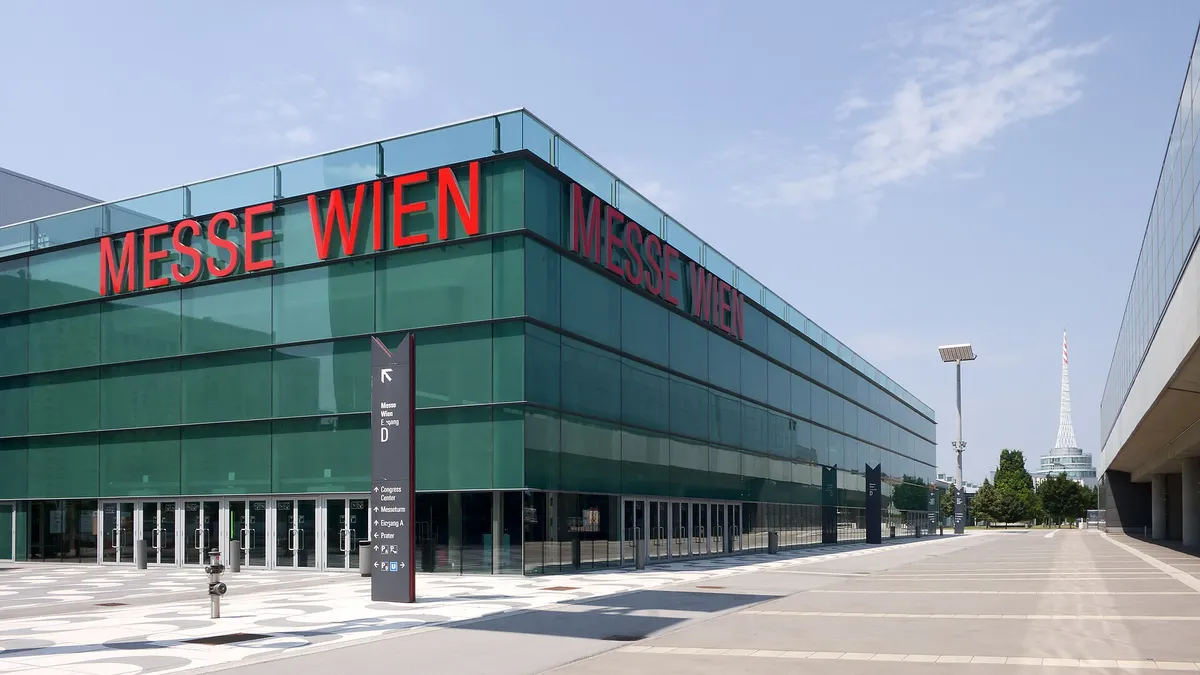
From 30 September to 4 October 2026, Vienna hosted the 26th EURETINA congress, the European reference meeting for retina specialists. Four doctors from our team participated: Dr Florian Baudin, Dr Florian Chaise, Dr Malik Merad and Dr Lorane Bechet. Here is what we take away from the main themes of the congress, and why this trip matters for you.
A world-scale congress
Under the presidency of Prof Nicole Eter (Münster), the congress brought together participants from over 140 nationalities. Among the novelties of this edition: a ‘World Retina @ EURETINA’ space dedicated to international exchanges, a renewed forum for free communications and a scientific poster hub, as well as joint sessions with patient associations, notably on hereditary retinal diseases.
The main themes of the retina
Geographic atrophy, an advanced form of AMD
The subject ran through the programme. Today, no treatment restores lost vision, and to our knowledge, drugs that slow down atrophy have not obtained marketing authorisation in Europe. The research presented therefore explores other avenues:
- Gene therapy: a product modifying the complement pathway (OCU410), for which the manufacturer reports, in a phase 2 trial, a reduction of approximately 31% in lesion growth at 12 months; another candidate targeting the complement has started its phase 1/2.
- Cell therapy: interim phase 2 results have been presented for pigmented epithelial cells (data reported by the sponsor).
- Optogenetics: a gene-independent approach aiming to restore light sensitivity in Stargardt disease and geographic atrophy.
These figures come from industry and conference abstracts: they are encouraging but remain to be confirmed by larger trials and sufficient follow-up. For reference, a retinal implant has already shown reading results in some patients with advanced geographic atrophy.
Intravitreal injections in real life
Data from the VOYAGER real-world programme have been presented for faricimab in exudative age-related macular degeneration, diabetic macular oedema and retinal vein occlusions: a useful point as they reflect daily practice and not just controlled trials (see also our article on age-related macular degeneration and diabetic macular oedema).
Why continuing education is essential
The retina is one of the specialities where medicine evolves the fastest: new molecules, new imaging techniques (OCT, OCT angiography), surgery and artificial intelligence. Continuing to learn allows:
- to offer the most up-to-date treatments and to know their limits, so as not to promise what science has not yet proven;
- to compare one’s practices with those of other European centres and to discuss complex cases;
- to evaluate without delay the arrival of new treatments or devices.
This is an approach that our team pursues regularly: after ICOOR and Floretina in Florence or the Lyon Œil Rétine 2025 congress, this trip to Vienna fits into the same logic of expertise and permanent updating in the service of the patients of the ophthalmology department of the Centre médical des Aravis (Argonay, Faverges, Rumilly and Sallanches).
Learn more
Find our retinal pathologies (age-related macular degeneration, diabetic retinopathy, retinal detachment) or book an appointment with one of our retinologists.
Sources
- Ophthalmology Times – Vienna calling: inside the 26th EURETINA congress
- Ophthalmology Times – Geographic atrophy featured across the EURETINA 2026 scientific programme
- Ophthalmology Times – EURETINA 2026: gene therapy sessions to watch in Vienna
- Retina International – Programme at EURETINA 2026
Your ophthalmologist answers your questions during the consultation. For a sudden symptom or sudden loss of vision, seek advice promptly: see the eye emergencies page.