
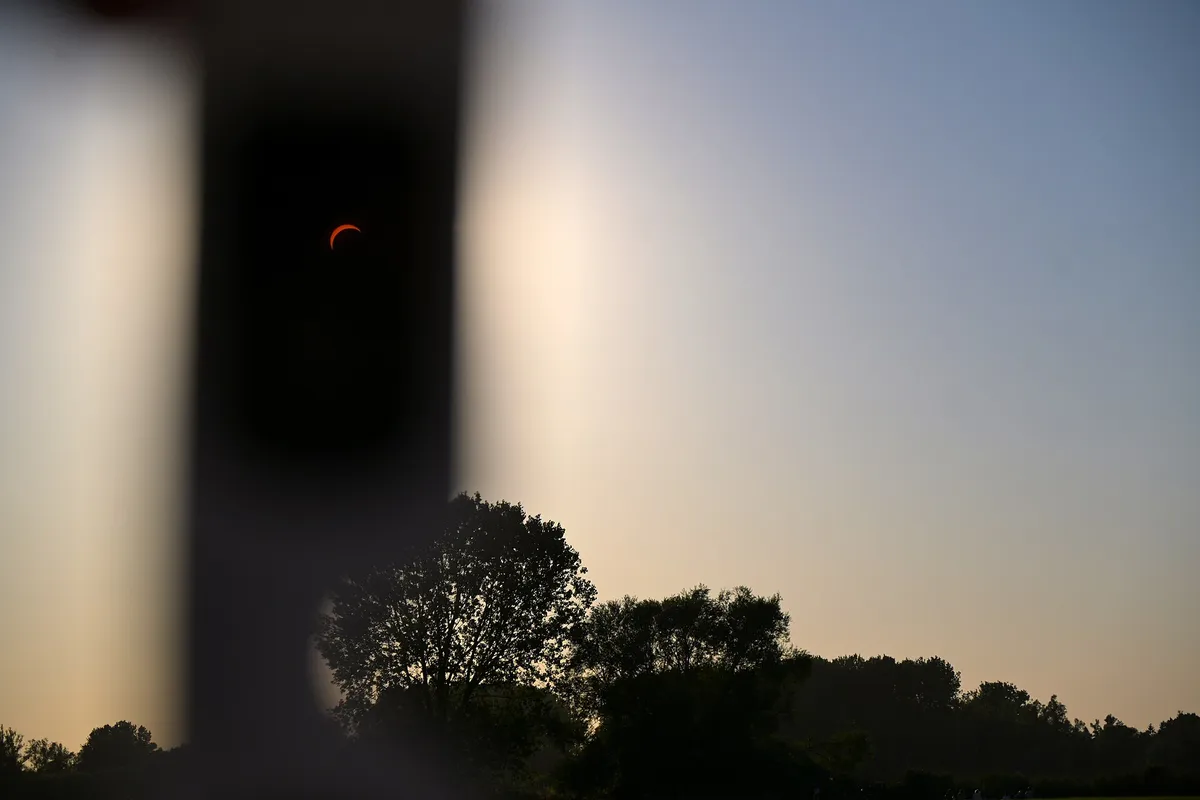
On 12 August 2026, a solar eclipse will be visible from France. It will be total in parts of Spain, Iceland and Greenland, and partial throughout mainland France. In the evening, the visible phase will occur between about 19:10 and 21:20, depending on location. The Sun will be low on the horizon, but will still be dangerous to look at.
Why the risk is real
Looking at the Sun without protection, even briefly or even partially obscured, can cause a retinal burn (solar retinopathy). The injuries affect the macula, at the centre of the retina, and may be irreversible. As the retina does not contain pain receptors, one feels nothing at the time: the symptoms (dark or distorted spot at the centre of vision, decreased acuity) appear a few hours later. During the 1999 eclipse, a national monitoring of ocular complications had indeed been set up.
The right glasses
- It requires eclipse observation glasses compliant with the ISO 12312-2 standard, with CE marking. Ordinary sunglasses, even very dark ones, are not sufficient.
- Check the filter. Discard the glasses if the filter is scratched, punctured or torn.
- Beware of counterfeits: instructions only in English, lack of clear marking, unknown seller. Health authorities anticipate stock shortages: it is better to equip oneself several days in advance, at a pharmacy, with an optician or at a reliable sales point.
- Keep them during the entire observation, even if the sky is cloudy.
What to avoid
- Looking at the eclipse through sunglasses, X-ray films, smoked glass or photographic negatives.
- Using binoculars, a spotting scope, a camera or a smartphone without a certified solar filter in front of the optics: the concentrated light increases the risk.
- Allowing children to observe alone: they are more tempted to look without protection.
What to do next?
If, in the hours or days that follow, you notice a spot, a distortion of straight lines or a decrease in vision, consult an ophthalmologist quickly (see ophthalmological emergencies). An examination of the macula with OCT allows to confirm or rule out a lesion.
Sources
- info.gouv.fr – FAQ sur l’éclipse solaire 2026
- ARS Auvergne-Rhône-Alpes – Éclipse solaire du 12 août 2026 : conseils pour observer le phénomène en toute sécurité
- sante.fr – Éclipse solaire du 12 août 2026 : protégez vos yeux
- Ordre des pharmaciens – Prévention des accidents oculaires lors de l’éclipse solaire du 12 août 2026
- CNES – Éclipse solaire du 12 août 2026
Your ophthalmologist answers your questions during the consultation. For a sudden symptom or sudden loss of vision, seek advice promptly: see the eye emergencies page.