
Headlines often suggest that ‘a simple eye examination could predict Alzheimer’s disease or a heart attack’. The retina is the only place in the body where blood vessels and nerve tissue can be observed directly without surgery. How much do the findings support those claims?
Why the retina interests researchers
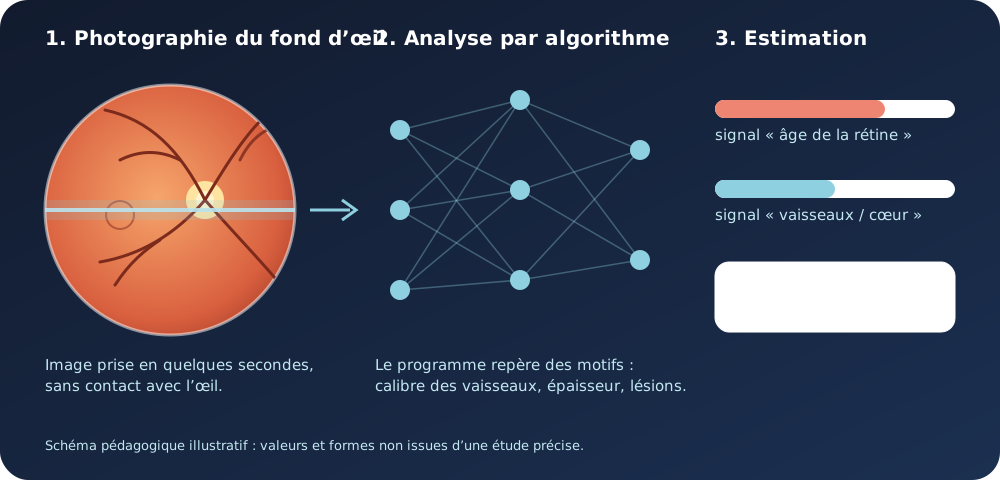
The retina is an extension of the brain, and its small vessels reflect the state of the body’s circulation. Fundus photographs and OCT images (retinal cross-sections) contain a lot of information. Artificial intelligence can spot patterns invisible to the human eye: this is sometimes called ‘oculomics’.
What the studies show
- Retinal biological age: a deep learning algorithm, published in Alzheimer’s & Dementia, estimates the ‘biological’ age of the retina from standard photographs. A biologically older retina would be associated with a 25 to 40% increase in the risk of cognitive decline or dementia over five years, for each additional standard deviation.
- Alzheimer’s risk factors: work from the University of Florida indicates that common retinal photographs can help predict risk factors. A study from the University of Otago identified biomarkers in the retina, while reminding us that it is still necessary to determine whether retinal thinning predicts the disease or just normal aging.
- Cardiovascular risk: a British algorithm combining AI and retinal vessels (QUARTZ), tested on over 7,000 people, achieves performances comparable to a classic risk score (Framingham); in diabetic patients, retinal vascular parameters are associated with cardiovascular events at 10 years.
The limitations to keep in mind
- These are association or prediction studies: they do not prove that retinal screening improves patient outcomes.
- The performances depend on the studied population and the quality of the images; they are rarely validated in real life.
- A result that indicates increased risk is not a diagnosis. It is a reason to seek a medical assessment, not to assume that you have the condition.
- An ‘Alzheimer’s eye test’ offered online or in shops today has no established medical value.
What this changes in practice
The immediate interest lies elsewhere: AI already helps to detect diabetic retinopathy, AMD or glaucoma from images, and to quickly analyze examinations (our imaging equipment). The crossings with the heart or the brain are promising but to be confirmed. The good reflex remains a regular ophthalmological examination: it detects eye diseases and can reveal signs of hypertension or diabetes.
Sources
- Pourquoi Docteur – Risque de démence : un scanner oculaire alimente l’IA pour le prédire
- Pourquoi Docteur – Alzheimer : un test oculaire pour détecter la maladie avant les symptômes
- Pourquoi Docteur – Crise cardiaque, AVC : un test pour prédire les risques
- Le Quotidien du Médecin – Dépister grâce aux fonds d’œil
Your ophthalmologist answers your questions during the consultation. For a sudden symptom or sudden loss of vision, seek advice promptly: see the eye emergencies page.