

“Blind patients can read again”: The international press has widely reported on the results of a retinal implant called PRIMA, published in the New England Journal of Medicine since October 2025. What are the real implications, and who is this for?
What disease is involved?
This is geographic atrophy, the advanced stage of dry AMD: the cells in the macula, the central part of the retina, gradually disappear. The patient loses central vision (reading, recognising faces) while retaining peripheral vision, which allows them to move around. No treatment can restore the lost vision, and medications that slow the progression of the atrophy have not, to our knowledge, been approved in Europe.
How does the implant work?
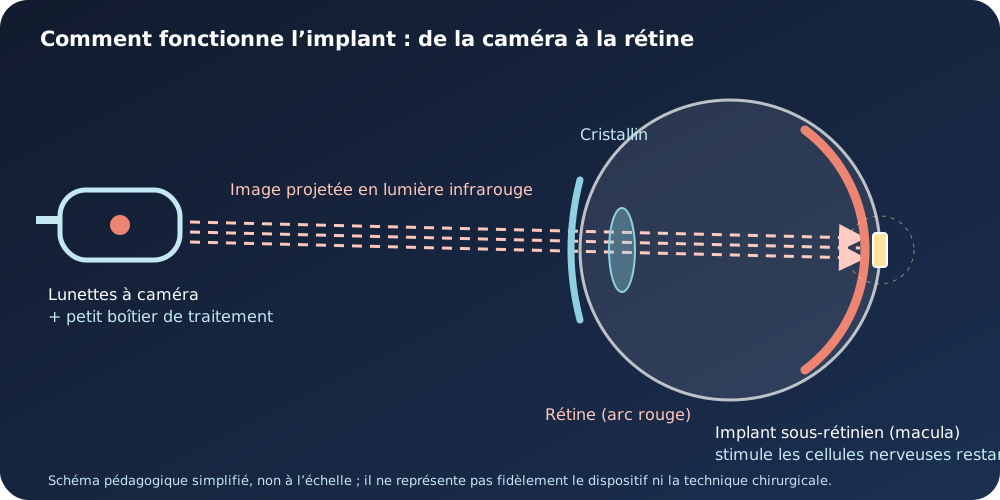
A tiny photovoltaic chip is placed under the retina, replacing the damaged area. The patient wears glasses equipped with a camera: the image is projected as infrared light onto the chip, which stimulates the remaining nerve cells; a small device processes the image. The vision obtained is not that of a healthy eye: it is artificial and requires training.
What the trial showed
- A multicentre study of 38 patients at 17 centres in five countries, coordinated by Professor Frank Holz in Bonn.
- More than 80% of patients were able to read letters, numbers, and words; the average reported gain is approximately 25 letters, equivalent to more than five lines on a reading chart, with some patients able to read pages from a book.
- Surgery-related adverse events have largely resolved within two months; an independent committee judged that the benefits outweighed the risks.
Important limitations to be aware of
- The indication is for advanced forms with severe loss of central vision, not for early AMD.
- The surgery is complex and is reserved for specialized centers.
- The information primarily comes from the manufacturer; long-term outcomes remain to be established.
- A small preliminary study reported faster progression of geographic atrophy in implanted eyes compared with non-operated eyes: an important point to monitor.
What this means for patients today
This is a real advancement for a condition without cure, but not a cure. In practice, early detection of AMD remains the best approach: improved vision starts with macular examination (OCT) and regular follow-up (retinal conditions).
Sources
- Retinal Physician – Implant restores central vision in GA (2025)
- Eyewire – NEJM publishes study demonstrating vision restoration with a retinal implant
- Manufacturer’s press release (Science Corp.), 20 October 2025. A commercial source to interpret with caution.
Your ophthalmologist answers your questions during the consultation. For a sudden symptom or sudden loss of vision, seek advice promptly: see the eye emergencies page.