

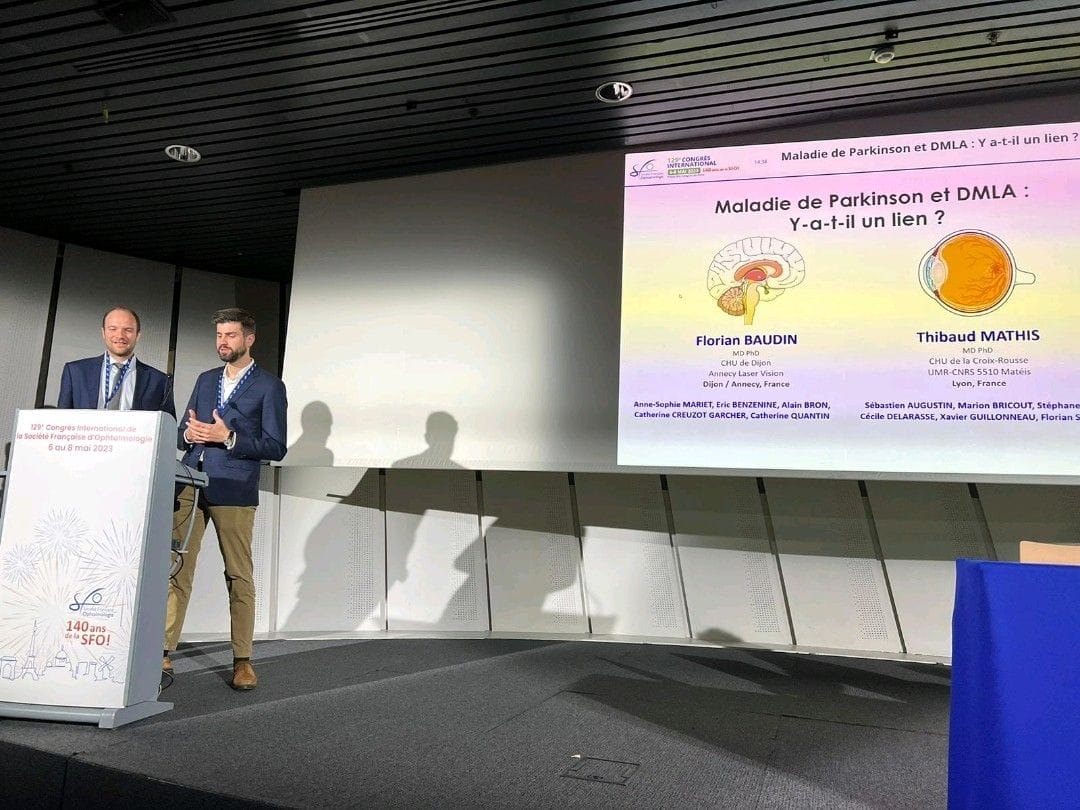
AMD and Parkinson's Disease: Is there a link?
Context
Présentation lors de la Retina Session of the French Society of Ophthalmology (SFO) 2023 des premiers résultats épidémiologiques et expérimentaux de l'intérêt des traitements dopaminergiques dans la prévention de la survenue et de l'évolution d'une DMLA néovasculaire.
An innovative translational design combining big data and fundamental research, made possible by the collaboration of several centres, each expert in their field.


Summary
Parkinson's Disease and AMD: Is there a link?
Parkinson's disease and age-related macular degeneration (AMD): is there a link?
Baudin F (1); MATHIS T (2); Mariet AS (1); Benzenine E (1); Sennlaub F (3); Bron AM (1); Creuzot-Garcher C (1); Quantin C (1)
(1) Dijon; (2) Lyon; (3) Paris, France
Introduction
Levodopa (LDOPA), a Parkinson’s medicine, activates GPR143 in retinal pigment epithelial cells. This significantly increases pigment epithelium-derived factor (PEDF), which reduces VEGF production. Studies suggest that levodopa alone may delay the onset of neovascular age-related macular degeneration (AMD) and reduce subretinal fluid, with good tolerability. We sought to assess the impact of dopaminergic treatment in patients with neovascular AMD.
Materials and Methods
Using a French national health insurance database covering people who received intravitreal injections, we developed an algorithm to identify patients injected for neovascular AMD who had at least 2 years of follow-up after their first injection. We extracted age at first anti-VEGF injection, sex, diabetes, hypertension and dyslipidaemia status, numbers of intravitreal injections in the first and second years, and the classes and daily doses of Parkinson’s medication.
Results
From January 2008 to December 2016, 202,629 patients were treated for neovascular AMD. Among these patients, 9,117 were treated with "dopaminergic" and "other dopaminergic" medications; among them, 7,915 were treated with levodopa and its derivatives and/or dopamine agonists. The average age (mean ± standard deviation) at the time of the first anti-VEGF injection was 79.5 years (±8.1). Patients treated with levodopa and its derivatives, or dopamine agonists, were older at the time of the first anti-VEGF injection than naive patients with neovascular AMD who were not treated with Parkinson's disease medication, 83.1 years (±5.7) and 81.3 (±7.1) vs 79.4 (±8.1), respectively (p<0.0001). Diagnosis at an older age remained associated with treatment in the multivariable analysis, accounting for hypertension, diabetes, dyslipidaemia, sex and use of antineoplastic or HIV medicines (p<0.0001). Patients on levodopa or its derivatives received fewer intravitreal injections in the first year, second year and two years combined: 4.5, 1.9 and 6.4, versus 4.9, 2.5 and 7.3 for patients who had never taken Parkinson’s medication (p<0.0001). This remained significant after multivariable analysis (p<0.0001). A higher daily dose of levodopa or its derivatives was associated with fewer injections in the second year: 0.32 fewer injections per 250 mg/day of levodopa (p=0.02).
Discussion
Given the risks of intravitreal anti-VEGF injections, including retinal detachment and endophthalmitis, a well-tolerated systemic treatment would be valuable even if it only reduced the number of injections. Our study found that association for levodopa and its derivatives. It was stronger in the second year, possibly because patients typically start anti-VEGF on a fixed schedule in the first year, with later dosing adjusted to disease activity. Because relatively few patients have exudative AMD and receive Parkinson’s medication, this analysis required a national database. We subsequently compared our observations with findings in mouse models.
Conclusion
Levodopa and its derivatives may offer an additional treatment option for neovascular AMD.
À lire aussi
Your ophthalmologist answers your questions during the consultation. For a sudden symptom or sudden loss of vision, seek advice promptly: see the eye emergencies page.