

Regain clear near vision without glasses thanks to a few drops: the idea is appealing, and articles dedicated to eye drops against presbyopia are among the most read. A progress report, a few months after our article on drops based on aceclidine.
The principle: a ‘pharmacological pinhole’
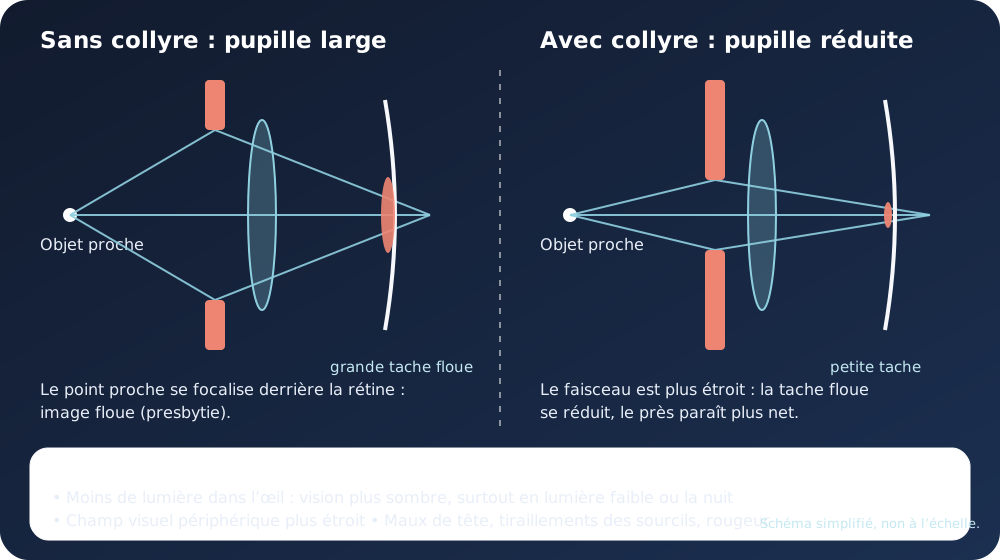
These eye drops constrict the pupil. Like a camera diaphragm, a smaller pupil increases the depth of field: nearby objects become clearer, without correcting the cause of presbyopia, which is the loss of flexibility of the lens. The effect is temporary, lasting a few hours.
Two families of products
- Pilocarpine, known for a long time in glaucoma. At low concentration, a formulation (Vuity) was the first approved in the United States for presbyopia and marketed in 2022. It also acts on the ciliary muscle, which can cause headaches, eyebrow tugging and, more rarely, vitreoretinal problems.
- Aceclidine (Vizz), approved by the American FDA: it acts mainly on the pupil without notably stimulating the ciliary muscle, which could limit certain effects. A commercial launch in the United States was announced for 2026.
Adverse effects to be aware of
Darker vision, especially in low light or night driving, visual discomfort, headaches, redness. Patients who have a risk of retinal detachment, a retinal pathology or glaucoma should discuss this with their ophthalmologist: pilocarpine is not harmless.
And in France?
As of the date of this article, we have not found any authorization or opinion from the ANSM for these eye drops against presbyopia in France: most of the published information concerns the United States. Products sold online without a prescription raise quality and safety issues. The pilocarpine eye drops available in France have another indication, notably glaucoma, and should not be misused.
So, glasses, contact lenses or surgery?
The tried-and-tested solutions remain progressive lenses, multifocal contact lenses and, for some patients, refractive surgery or lens replacement (cataract and multifocal implants). A consultation allows you to choose according to your lifestyle, age and eye condition. Also find our summary on the consensus on presbyopia.
Sources
- New Atlas – Age-related near-sighted drops: Vizz
- Turkish Journal of Ophthalmology – Pharmacological pinhole in presbyopia treatment: from pilocarpine to aceclidine (2025)
- Drugs & Aging – Revue sur les collyres contre la presbytie
Your ophthalmologist answers your questions during the consultation. For a sudden symptom or sudden loss of vision, seek advice promptly: see the eye emergencies page.