

We are proud to announce the publication of a scientific article in the prestigious Journal of Clinical Investigation, one of the medical journals with the highest impact factors (40th) , co-authored by Dr Florian Baudin. This research work explores innovative mechanisms for treating Age-related Macular Degeneration (AMD), a disease with devastating effects on vision, exploring links with Parkinson’s disease.
Age-related macular degeneration (AMD) is the leading cause of vision impairment in people over 50. Research, conducted by various French laboratories and led by Thibaud Mathis, a university professor and hospital practitioner in the ophthalmology department of the Croix-Rousse Hospital (Hospices Civils de Lyon), as well as by Dr. Baudin’s team, which specializes in analyzing big data, “opens the way to an innovative treatment for the neovascular form of AMD.”
Currently, the standard treatment involves intraocular injections of anti-angiogenic drugs, which must be administered very frequently: often every month for the first six months, then on average every two months, and for life. These injections are not without risks, as they can lead to eye infections. Furthermore, they represent a significant cost for the healthcare system and generate a large influx of patients for ophthalmologists, making their management complex. It is therefore crucial to find safer, less restrictive, and less expensive alternative therapies.
Study Objectives
The paper highlights the role of the DRD2 receptor in reducing choroidal neovascularisation, a process involved in the progression of AMD. Choroidal neovascularisation means new blood vessels grow beneath the retina. They can leak fluid and impair vision. Activating the receptor might slow or stop this abnormal growth, offering a possible avenue for patients.
Indeed, patients treated with Parkinson’s medication show a less severe form of neovascular AMD, with a later onset and requiring fewer injections (See figure).
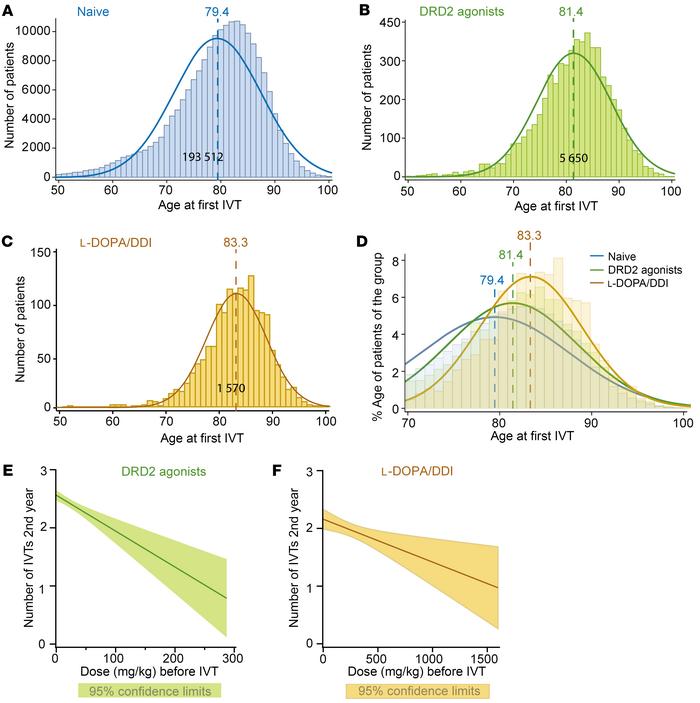
Incidence of nAMD and frequency of anti-VEGF injections are reduced in PD patients treated with l-
DOPA/DDI and DRD2 agonists.
The Contribution of Big Data to Research
Dr Florian Baudin and his team led the study’s data analysis. They used large-scale methods to analyse millions of data points from patient databases. Comparing many cases helps produce more robust results and identify previously unsuspected factors.
The analysis of data from more than 200,000 French patients treated for AMD supported laboratory findings from Professor Mathis’s team. Parkinson’s medicines acting on dopamine receptors may have a protective effect or complement intravitreal anti-VEGF treatment.
This has shown that patients taking anti-Parkinsonian drugs reported a later onset of exudative AMD at age 83 compared to 79, as well as a less severe form. Alternatively, there was an added benefit when combined with intraocular injections, as fewer injections were required compared to patients not taking anti-Parkinsonian medication.
Big data is now providing a valuable advance in medical research, by combining various pieces of information to obtain faster and more personalized results for each patient.
What does this mean for patients?
“It has been shown that patients taking this type of medication developed less AMD than others, or that the disease was less severe in them. They needed fewer injections than patients who were not treated with this Parkinson’s medication. Our research has shown that this drug limits the production of abnormal blood vessels in the eyes of patients with AMD” explains Thibaud Mathis.
For patients with AMD, these advances represent a great hope. AMD is the leading cause of blindness in older people. If this research can be translated into clinical treatments, it could transform the management of the disease by delaying, or even preventing, vision loss. This would lead to a better quality of life, with less invasive and more targeted solutions.
Useful References
- Age-related macular degeneration (AMD) – INSERM
- Use of Big Data in Ophthalmology – theses.fr Dr. BAUDIN
- CNRS Press Release
- INSERM Press Release
- Le Progrès
- France 3
- Medscape.fr
Your ophthalmologist answers your questions during the consultation. For a sudden symptom or sudden loss of vision, seek advice promptly: see the eye emergencies page.